
Safety and Health
Safety and Health Policy
Kumagai Gumi places safety and health at the core of its corporate activities, prioritizing the respect for human life above all else, and is committed to preventing occupational accidents. We comply with social norms, laws, our own internal standards and other rules, and we have established a Safety and Health Management System. We shall implement this system in a highly effective way to adapt to changes in the business environment and address problems.
Guiding principles for action
- We shall utilize a line and staff management system to ensure the Safety and Health Management System operates effectively.
- We shall secure the necessary management resources and continually enhance our safety and health initiatives.
- We aim to clearly define responsibilities and authorities and strive to improve the capabilities of our employees and specialized contractors through training.
- We aim to implement organizational initiatives to create comfortable work environments and maintain and enhance the physical and mental health of our employees and all those involved in construction work.
- We aim to enhance the safety and health management standards of all specialized contractors by strengthening our collaboration with the Yuuei Kyoryoku Kai.
January 2025
Safety and Health Management System
The conduct of its business, the Kumagai Gumi Group prioritizes respect for human life and maintains high health and safety management standards to prevent labor accidents, improve health, and create comfortable working environments.
We comply with social norms, laws, our internal standards, and other rules, and have established a Safety and Health Management System which we operate with high effectiveness.
- Average frequency during the Medium-Term Management Plan period: 0.5 or less
Kumagai Gumi led the industry by adopting the Kumagai Gumi Occupational Safety and Health Management System (OSHMS) in 1999. Since then, our safety performance has steadily improved and the system has greatly contributed as a method for preventing occupational accidents.
COHSMS Certification
The Japan Construction Occupational Safety and Health Association started the COHSMS (Construction Occupational Health and Safety Management System) certification business from 2008 in order to widely spread the "Policy on Occupational Safety and Health Management Systems" published by the Ministry of Health, Labour and Welfare in April 1999.
Kumagai Gumi has obtained company-wide certification #1, and has since updated the certification each year by receiving an examination.
In 2018, the “NEW COHSMS,” which addresses the environmental shift of the construction industry and the ISO 45001 international standard, was released, and we made updates to suit the renewal audit in 2020. Since that time, maintenance audits have been conducted on an annual basis.
System Features
- System unified over the entire company (company standard)
- Conducting risk assessment via a database of disaster information and safety and health patrol information
- Including guidance and education for specialized contractors and clarifying responsibilities
- Enhancing our line and staff management system (clarifying the responsibilities of each department)
- Streamlining the saving of safety and health records
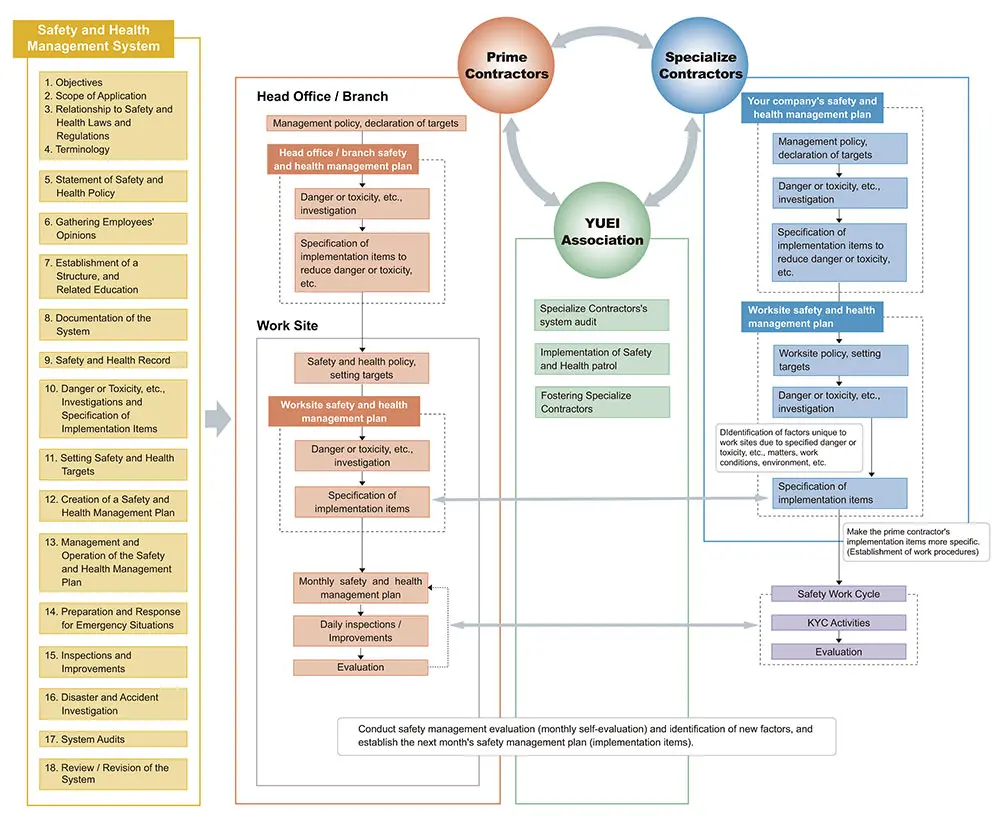
Safety risk management and supervision by top management
The President serves as the chief executive overseeing safety and health, and a Branch Safety and Health Committee is established at each branch, h eaded by each Branch Manager. During Safety Week and at the end of the year, the President, Vice Presidents and other members of senior management (executives in charge of safety) conduct patrols to raise awareness of safety spearheaded by the executives themselves.
Line and staff management system to enhance awareness on the prevention of occupational accidents
Adopting this system has enabled safety management to also be executed for the construction department line with clearly defined roles and responsibilities and positioned the safety department within company staff to improve our safety performance.
Educating employees on safety and health and enhancing system operation
Safety and health education is positioned as an important factor for preventing occupational accidents, and we strive to improve knowledge regarding safety and health management, system operation, and problems and improvement measures, etc.
- Branch office safety and health education
8 hours or more of education every year - Head office safety and health education
2 or 3 days of education 5 years, 9 years, and 21 years after entering the company
Verifying the PDCA cycle
It is important to operate the system well in order to prevent occupational accidents. System audits are conducted by auditors in order to understand the system and verify whether it is operated according to the safety and health management plan.
Status of labor accidents
| (total at the end of each fiscal year) | FY2020 | FY2021 | FY2022 | FY2023 | FY2024 |
|---|---|---|---|---|---|
| Frequency | 0.32 | 0.63 | 0.69 | 0.98 | 0.74 |
| Severity | 0.28 | 0.10 | 0.77 | 0.39 | 0.32 |
| Number of accidents resulting in 4 or more days off work (deaths) | 9 cases(1) | 16 cases | 15 cases(2) | 22 cases | 20 cases (1) |
Sharing information on health safety and prevention recurrence/Active efforts for DX
In April 2021, we introduced the “Safety Portal System” to accumulate and centralize data. The results of safety and health patrols are compiled into a database and used for risk management, and we created a system for drafting formulating workplace Safety and Health Control Plans. We are also promoting DX through initiatives such as making safety and health patrols paperless, piloting remote patrols, implementing VR-based training, building a database of training program participants, and developing a system audit portal.
Safety education for employees
We established educational guidelines to improve the labor/occupational health and safety management capabilities of our employees, and conduct occupational Headquarters and branches.
Initiatives concerning foreign workers
Many foreign workers are active in the construction industry, and labor accidents involving these workers have increased accordingly.
We have translated our Workers' Basic Education booklet into foreign languages to provide basic safety and health knowledge and are supporting education for business operators. We are aiming to create safe and secure workplace environments or foreign workers by means including creating foreign language versions of the materials for occupational health and safety education performed when entering work sites, to promote understanding of workplace rules.
Initiatives for safe work by elderly persons
We are strengthening initiatives to protect seniors, including placement of "thoughtfulness stickers" that encourage surrounding workers to warm to elderly persons, visualization of fall prevention measures, setting of age limits and permission systems for work that involves a risk of falls, and awareness education that encourages elderly persons to make use of their abundant experience while instilling self-awareness of physical weakening.
Through such efforts, in recent years we have reduced accidents involving elderly persons, which had been on the rise.
| (total at the end of each fiscal year) | FY2020 | FY2021 | FY2022 | FY2023 | FY2024 |
|---|---|---|---|---|---|
| Number of accidents involving workers aged 60 and over | 12 | 12 | 15 | 21 | 24 |
Risk and Opportunities
| Specific issues | Risk of inaction | Opportunities |
|---|---|---|
| Occupational healthy and safety |
|
|
| Securing skilled workers in the construction industry |
|
|