
Quality Control
Quality policy
As a leader in the construction service industry, which is an essential industry in society, Kumagai Gumi is committed to maintaining the integrity of its manufacturing and delivering reliable quality. We strive to demonstrate the Unique Worksite Excellence of Kumagai Gumi, aiming to achieve Quality that Inspires Happiness, a standard that responds to the feelings and expectations of the people who use our spaces.
- Unique Worksite Excellence: Utilizing our advanced technical capabilities alongside our skilled human resources.
- Quality that Inspires Happiness: This means buildings are of an external and functional quality that ensures that their users remain fully satisfied.
Guiding principles for action
- All members of our organization shall engage in sales, construction, and follow-up services with integrity to foster trust.
- We shall unite to demonstrate our outstanding collective strengths while considering the perspectives of our customers and users.
- We shall implement a quality management system as a part of our business processes and ensure that the PDCA cycle is utilized for continuous improvement.
- We shall ensure compliance with social norms, laws, regulations, our internal standards and other rules.
- We shall provide quality training to ensure that the concept of integrity in manufacturing and service is passed on to future generations.
January 2025
Basic policy of quality control
To focus on maintaining quality and manufacturing with integrity, Kumagai Gumi revised its former “Safety, Health, Quality, and Environment Policy” into a dedicated “Quality Policy” in 2025, establishing a set of guiding principles for action.
Kumagai Gumi is committed to delivering reliable quality while realizing “Quality that Inspiries Happiness,” a standard that responds to the feelings and expectations of those who use our spaces.
Quality and environmental management and promotion system
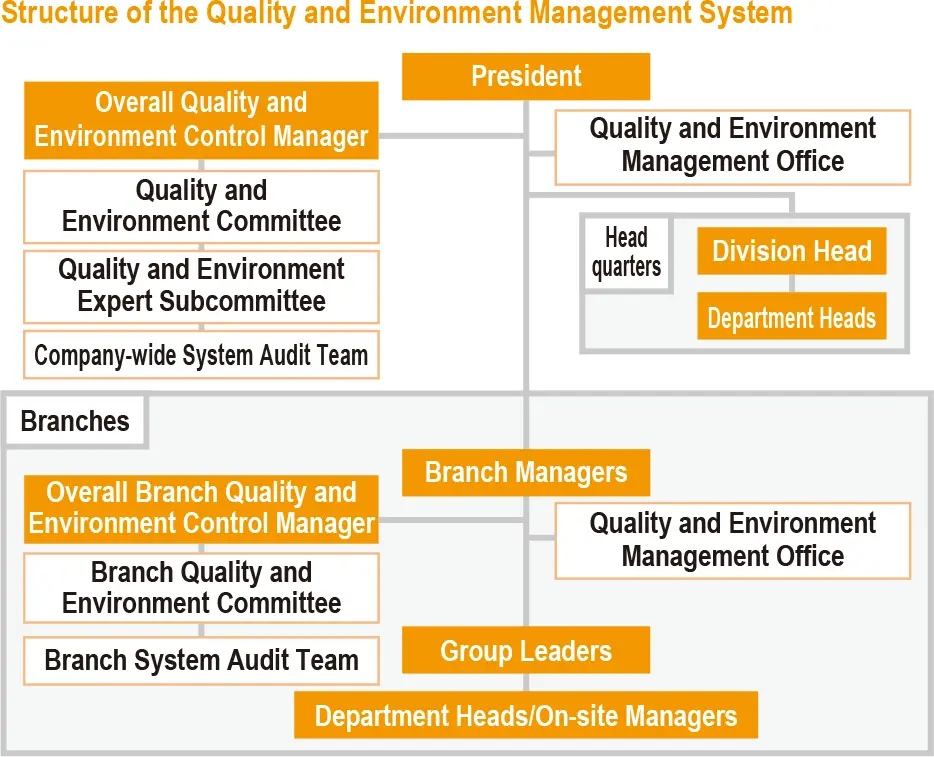
In April 2024, we established the Quality and Environment Management System Office, an organization that reports to the President, to enhance the management system and surveillance function in our quality and environmental management system as well as to ensure the effectiveness of quality control and environmental protection. Likewise, each branch now has its own Quality and Environmental Management Office, reporting directly to the branch manager. The Quality and Environment Committee, chaired by an Overall Quality and Environment Control Manager appointed by the President, and the Quality and Environmental Expert Subcommittees under it, examines concrete measures for quality and environmental issues, verifies the progress towards goals, assesses the progress, and examines the measures on a regular basis to verify and improve the validity of the management system.
Kumagai Gumi obtained ISO9001 certification in 1996 and ISO14001 certification in 1997. To further embed the management system into works, we consolidated the quality management system for quality control and the environmental management system for environmental protection in 2016 to operate the system as a unified organization.
Initiatives to enhance the effectiveness of quality control
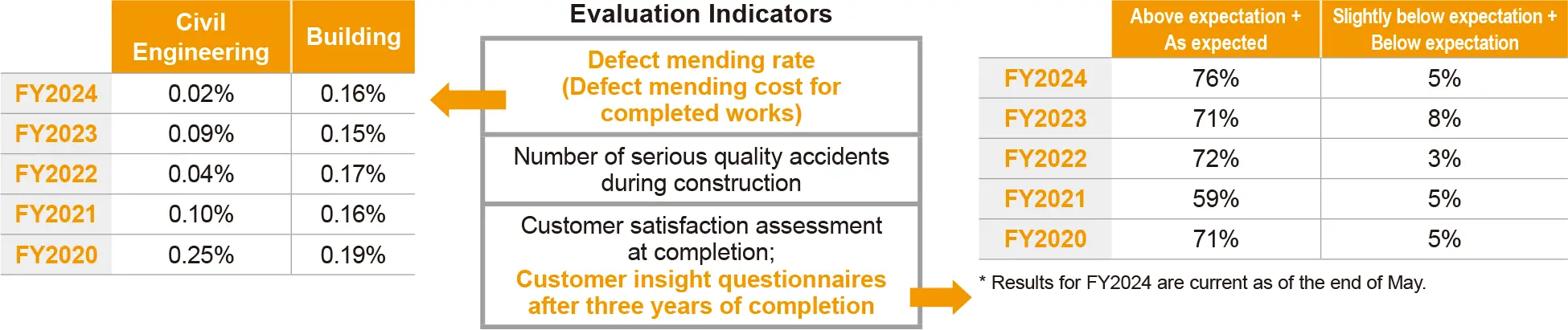
Kumagai Gumi sets evaluation indicator to measure the validity of its quality control activities, and promotes various initiatives for improvement. Furthermore, no serious quality-related incidents occurred during construction work in FY2024.
Risk and Opportunities
| Specific issues | Risk of inaction | Opportunities |
|---|---|---|
| Ensure quality and integrity in manufacturing |
|
|
| Strengthening compliance |
|
|
| Handing down skills and technologies |
|
|