
Corporate Governance
- Fundamental concepts
- Improvement of the Effectiveness of Internal Controls
- Evaluation of the Effectiveness of the Board of Directors
- Nomination & Compensation Advisory Committee
- Support System for Outside Executives
- Board of Directors Skills Matrix
- Directors’ Compensation and Selection of Outside Executives
- Stock-based compensation
- Cross Holding
Fundamental Concept
In order to realize our Management Philosophy, we consider enhancement of the efficacy of our corporate governance a priority issue.
Kumagai Gumi Corporate Governance ReportLast Updated: June 26, 2026
Corporate governance system
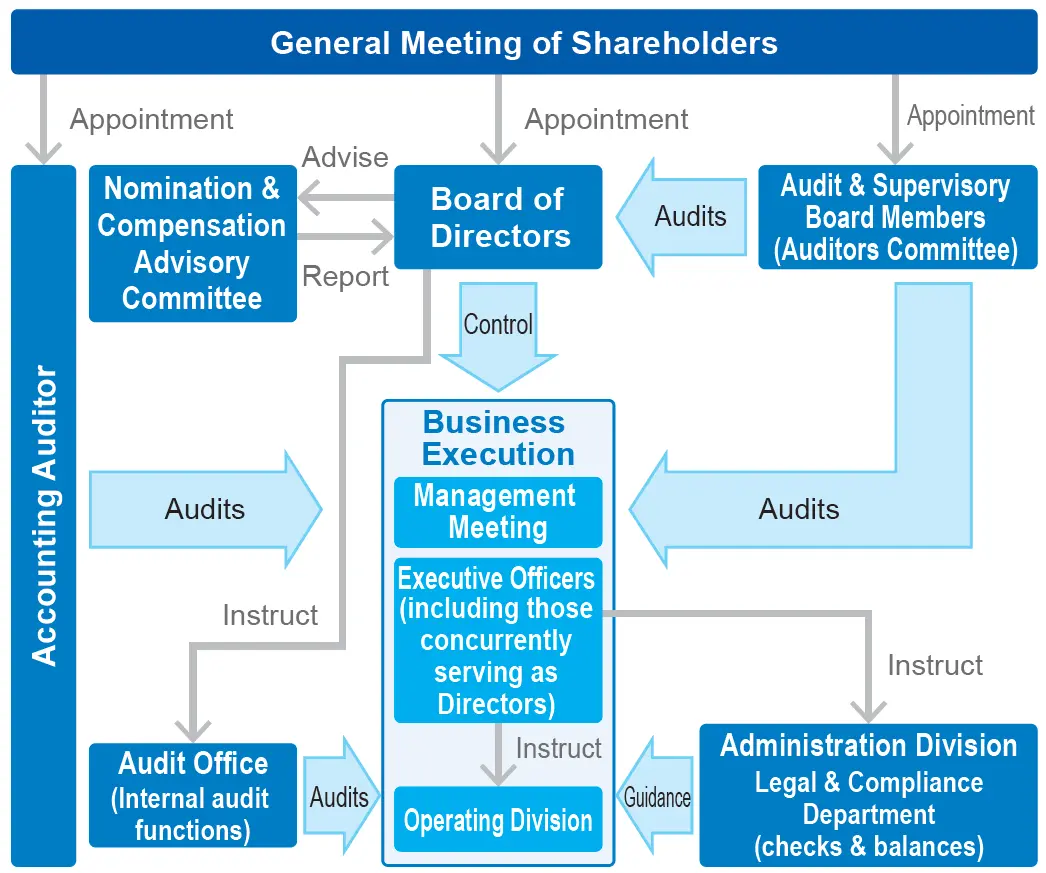
On June 27, 2025, Kumagai Gumi transitioned from a company with an Audit and Supervisory Board to a company with an Audit & Supervisory Committee.
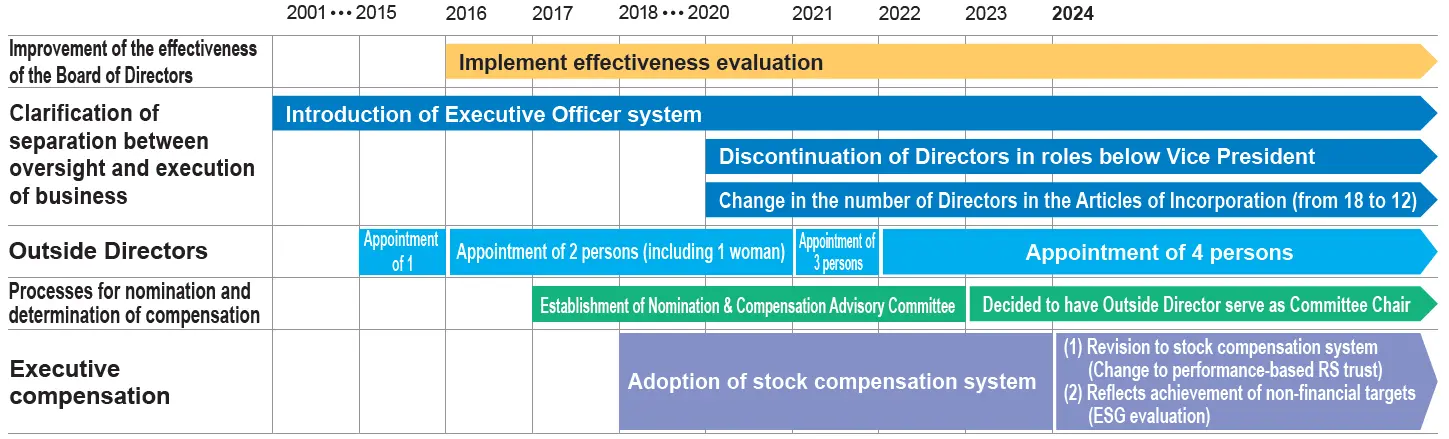
By appointing Audit & Supervisory Committee members to serve on the Board of Directors, we aim to further enhance the Board’s oversight function and reinforce our corporate governance framework. Additionally, by expanding the scope of delegation to directors responsible for key business execution, we promote a clearer separation between execution and oversight, while accelerating decision-making at the executive level.
The term of office for directors (excluding those who are Audit and Supervisory Committee members) is set at one year, ensuring clear accountability for management decisions and enabling the company to establish an optimal executive structure that can swiftly respond to changes in the business environment. We also adopt an executive officer system to ensure that the duties of directors (excluding those who are Audit and Supervisory Committee members) are executed efficiently. We also appoint five Outside Directors (excluding those who are Audit and Supervisory Committee members) who provide counsel to management from an objective standpoint.
In determining the nomination and amounts of compensation for Directors (excluding those who are Audit and Supervisory Committee members) and Executive Officers, we conduct deliberation within the Board of Directors on the basis of reports by the Nomination & Compensation Committee, which is composed of the Representative Director and Outside Directors.
As for the Audit & Supervisory Committee, we appoint Outside Directors from among persons who have appropriate experience and capabilities knowledge concerning finances, accounting, and legal matters, in order to conduct audits with high efficacy.
Regarding accounting audits under the Companies Act and the Financial Instruments and Exchange Act, we undergo impartial audits by GYOSEI & CO.
Corporate governance system at Kumagai Gumi
| Institutional design | Company with an Audit & Supervisory Committee | ||
|---|---|---|---|
| Composition | Directors: 12 (including 5 Outside Directors) | Includes 2 female executives (both are Outside Directors) | Includes 5 Independent Executives |
|
Ratio of female Directors: 16.7% | Ratio of Outside Directors: 41.7% | |
Major changes in strengthening of Corporate Governance
Improvement of the Effectiveness of Internal Controls
To enhance the effectiveness of internal controls, Kumagai Gumi reviews internal rules and management conferences appropriately, and otherwise improves and operates structures to assure appropriateness in work, based on our Basic Policy to Establish Internal Control Systems. In addition, the Kumagai Gumi Group as a whole undertakes the improvement and operation of internal control with the aim of maintaining the reliability of our f inancial reporting, based on the Financial Instruments and Exchange Act.
Evaluation of the Effectiveness of the Board of Directors
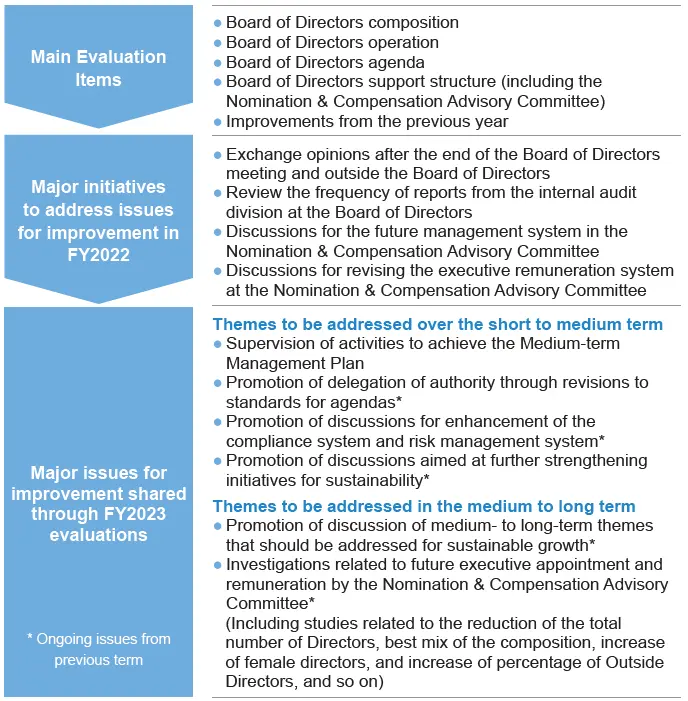
Once a year, Kumagai Gumi Directors and Audit & Supervisory Board Members take part in an anonymous questionnaire survey evaluating the effectiveness of the Board of Directors, and the results of which are verified by the Board of Directors to consider improvements.
In FY2024, self-evaluations were conducted (details in next section), and based on the findings of the reviews by outside experts, we confirmed that the Board is appropriately carrying out its role and responsibilities and that the efficacy of the Board of Directors overall is secured.
Based on the issues for improvement shared as a result of the FY2023 evaluation, we implemented improvement measures, and also worked to invigorate discussions at the Board of Directors meetings by holding extra meetings designed for Directors to exchange opinions.
Nomination & Compensation Advisory Committee
We set up the Nomination & Compensation Advisory Committee, an advisory body for the Board of Directors, composed of the Representative Director and Outside Directors. This Committee serves as both nomination committee and remuneration committee.
In FY2024, the Nomination & Compensation Advisory Committee gathered four times, each of which was attended by all committee members. In FY2024, we conducted deliberations on matters including the evaluation of contributions made by Directors and executive officers on FY2023 performance, individual remuneration amounts for FY2024, and the executive structure from FY2025 onward. We also examined the transition to a company with an Audit & Supervisory Committee, the future management structure, and revisions to the executive remuneration system.
In addition, as the right to make statements at the General Meeting of Shareholders has been granted, from June 27, 2025 onward, Outside Directors who serve as Audit and Supervisory Committee members selected by the committee will participate in the Nomination & Compensation Advisory Committee as observers.
Directorship Composition
(since June 27, 2025)
| Chairperson | Shigeru Okada | Outside Director |
|---|---|---|
| Members | Shin Ueda | President and Representative Director |
| Koji Okaichi | Representative Director | |
| Kimie Sakuragi | Outside Director | |
| Masaya Nara | Outside Director | |
| Observer | Miho Ueda | Outside Director (Audit Supervisory Committee Member) |
Support System for Outside Executives
To help outside executives complete their tasks in a smooth manner, the Secretarial Dept. of the Management Strategy Division and the Corporate Planning Department and other departments provide the Outside Directors with briefings of materials and agenda before the meetings.
The company provides various support to help them understand the company’s business, including opinion exchange opportunities for outside executives and inspection tours at construction sites.
Board of Directors Skills Matrix
Toward realizing our long-term Vision and achieving our Medium-term Management Plan goals, we have defined eight types of skill items required for the Board of Directors, which will play a central role in this effort: (1) Corporate Management/Management Strategy, (2) Sales/Marketing, (3) Global, (4) Technology/R&D/ DX, (5) Compliance/Risk Management, (6) Finance/ Accounting, (7) Sustainability (ESG/SDGs), and (8) Human Resource Development/Diversity.
Definitions of the skill items
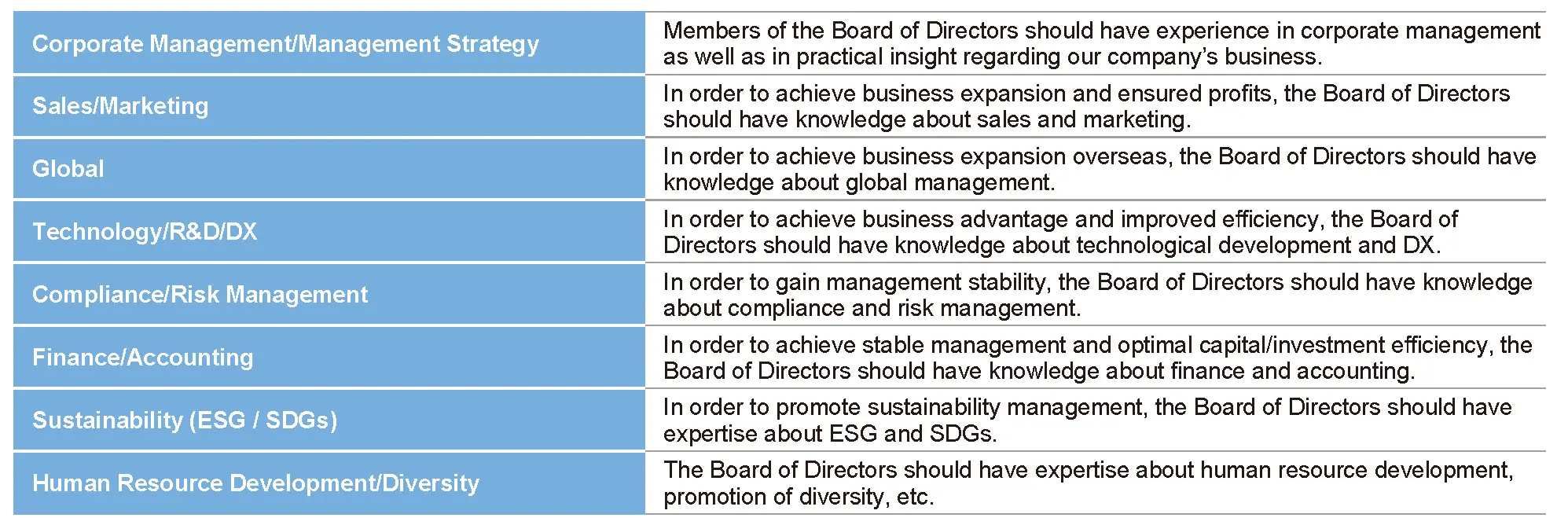
Skill items that our Board of Directors should have and that are particularly expected of each Director (up to 4 skill items for each Director, up to 2 skill items for each Director who is a member of the Audit & Supervisory Committee)
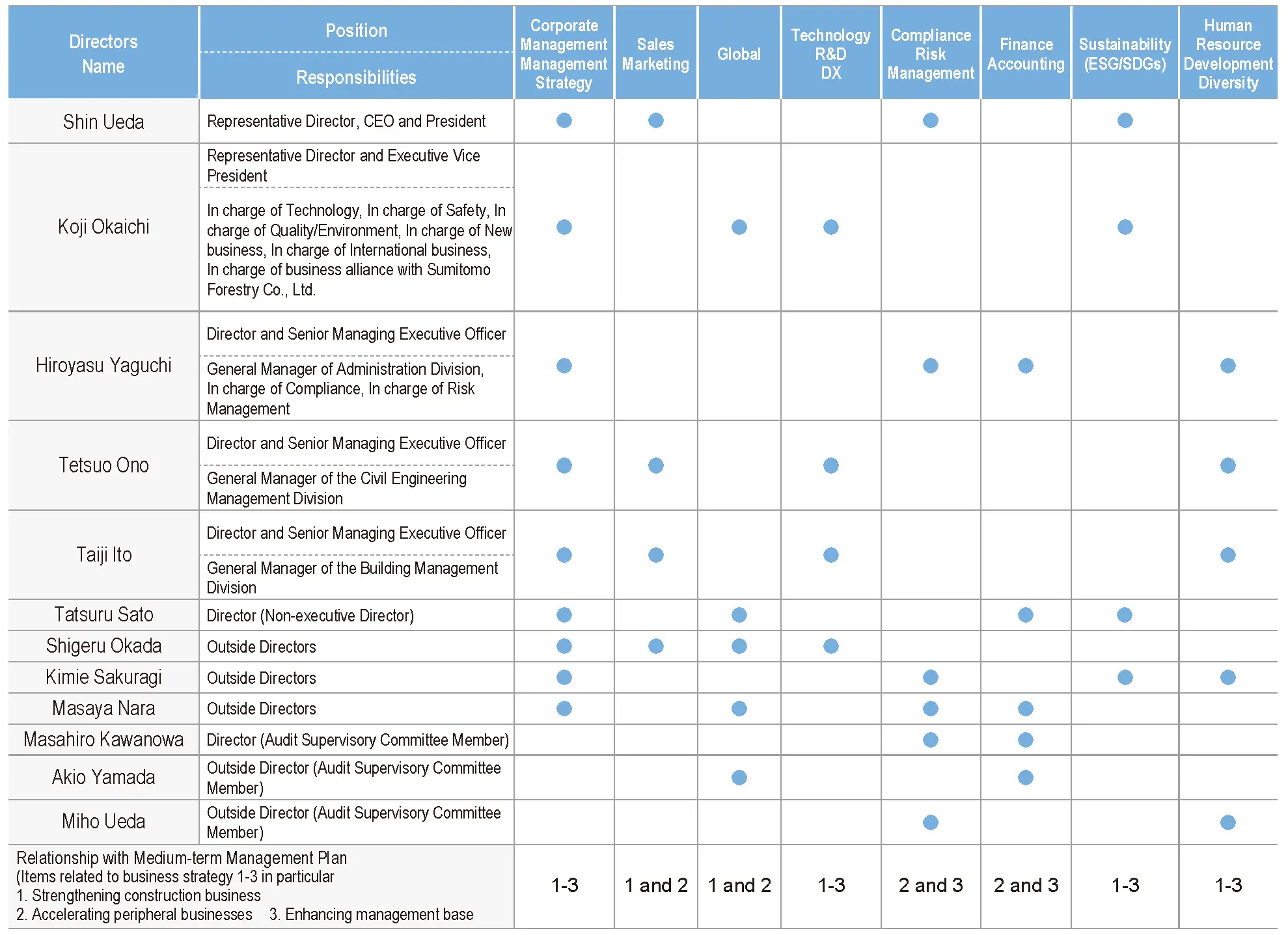
- These descriptions do not indicate all the knowledge, experience, and abilities possessed by each Director.
Directors’ Compensation and Selection of Outside Executives
Compensation for Directors (excluding those who are Audit and Supervisory Committee members) is based on a system of compensation linked to shareholder interests. When determining individual compensation, our basic policy is to set an appropriate level based on responsibilities. The amount of compensation is determined by the Board of Directors taking into account the results of reports by the Nomination & Compensation Committee within the limits on total amount of compensation for Directors decided at the General Meeting of Shareholders.
Specific compensation for Directors consists of monetary compensation (fixed compensation and bonuses) and stock compensation. For Outside Directors and part-time Non-executive Directors who bear supervisory functions, it consists of only monetary compensation (of fixed compensation, an amount of compensation according to position). The fixed compensation is monthly monetary compensation, and consists of compensation according to position and compensation according to contribution to business performance.
Compensation for Directors who are Audit & Supervisory Committee Members is determined through deliberation by the Audit & Supervisory Committee within the limit of the total amount of compensation for Directors who are Audit & Supervisory Board Members decided at General Meetings of Shareholders.
Compensation, etc. for Directors and Audit & Supervisory Board Members (FY2024)
Unit: millions of yen
| Executive category | Total amount of compensation | Total amount of compensation | Number of eligible Executives | ||
|---|---|---|---|---|---|
| Fixed compensation | Bonus | Stock compensation | |||
| Directors (Outside Directors among these) | 273 (43) | 251 (43) | - (-) | 21 (-) | 14 (4) |
| Audit & Supervisory Board Members (Outside Audit & Supervisory Board Members among these) | 39 (21) | 39 (21) | - (-) | - (-) | 3 (2) |
- The stock-based compensation noted is the amount of provisions for stock benefits for Directors recorded in FY2024.
Image of compensation composition for Directors (excluding Outside Directors and Non-executive Directors)
Figures in parentheses indicate the standard compensation ratio of total compensation
Compensation ratio in FY2024
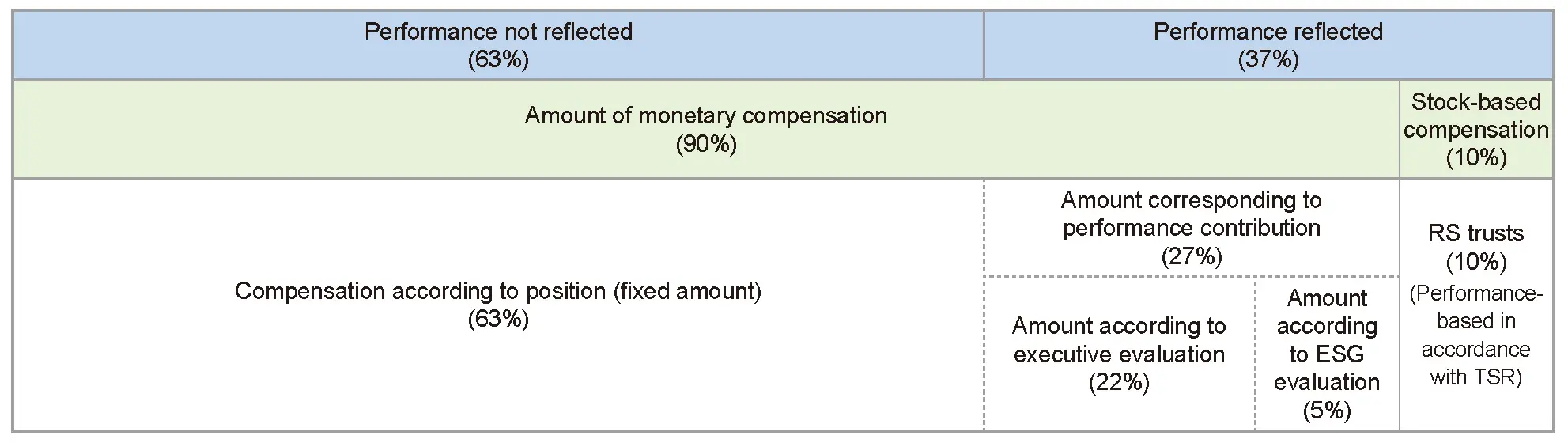
Amount of monetary compensation
1 Compensation according to position (fixed amount)
2 Amount corresponding to performance contribution
Amount corresponding to performance contribution: Compensation is granted based on the performance contribution in the previous fiscal year, with a variable between 0% and 200% (max.) for the amount corresponding to performance contribution. The list below shows the details of performance contribution evaluation and the indicators used.
(1) Executive evaluation
Ratio for each degree of achievement is set based on the job position.
- Performance achievement (company-wide performance): Consolidated ordinary income.
- Performance achievement (division performance): Operating income by division (including performance of major subsidiaries)
- Job role achievement (qualitative evaluation per individual)
(2) ESG evaluation
Evaluation on initiatives for the target value during the plan period regarding non-financial targets below in the Medium-term Management Plan.
- Non-financial Targets:
- CO2 emissions reduction activities (Scope 1+2/Scope 3 emissions reduction rates)
- Improvement on employee engagement (engagement rating)
- Improvement of safety management standards (frequency ratio)
- Establishment of internal and external systems to prevent legal violations (number of cases of serious violations of law and regulations)
Stock-based compensation
The company has adopted a stock compensation system that employs trusts, by which the company grants points based on position and total shareholder return (TSR) compared to the competitors selected by our company each fiscal year. Standards and procedures for share issuance is determined by the share issuance regulations defined by the Board of Directors.
Restriction of transfer until the executive retires is applied to the share granted every year.
Bonus
Payment of bonuses is considered if performance significantly exceeds that of the plans.
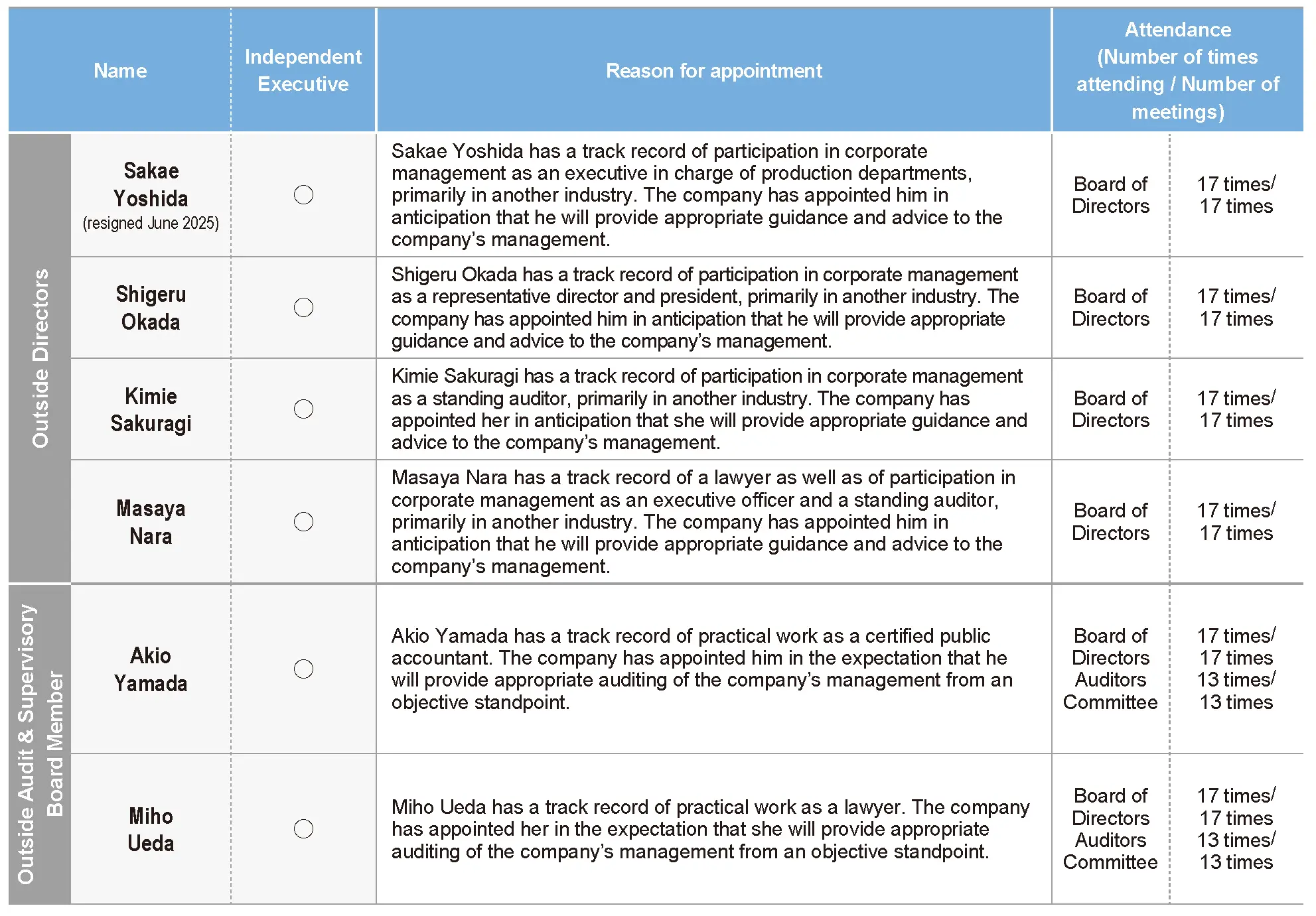
Reasons for appointment of Outside Executives / Attendance at Board of Directors meetings (FY2024)
Cross Holding
(1) Policy Concerning the Reduction of Cross Holdings
Kumagai Gumi will reduce the number of cross-held shares, except for such cases as transactions for enhancing sustainable corporate value, strengthening business alliance, and obtaining more opportunities to generate profits. With regard to the cross-held shares, the board meeting will verify the significance of holding such shares every year.
(2) The Significance of Cross Holdings
The company comprehensively reviews the significance of cross-held shares, examining whether the profits gained through various transactions with those companies are commensurate with our cost of capital, and whether continued shareholding is necessary.
(3) The Standards Regarding the Exercise of Voting Rights Associated with Cross Holdings
company shall do so by determining whether owning stock in another publicly traded company will increase the value of the corporations in which it invests. With regard to the following issues, among others, the Company will exercise its voting rights only after deliberate examination.
- Organizational restructuring, including the merger, acquisition, transfer, and/or takeover of an important business
- Retirement allowances to executives to be paid by an underperforming company, such as a company with excessive liabilities
- A planned third-party share issuance that may have the risk of being considered a favorable issuance
- Development of measures against M&A, implementation of counter measures, etc.