Carbon Neutral
Aiming to Achieve Carbon Neutrality
Greenhouse Gas Reduction Targets
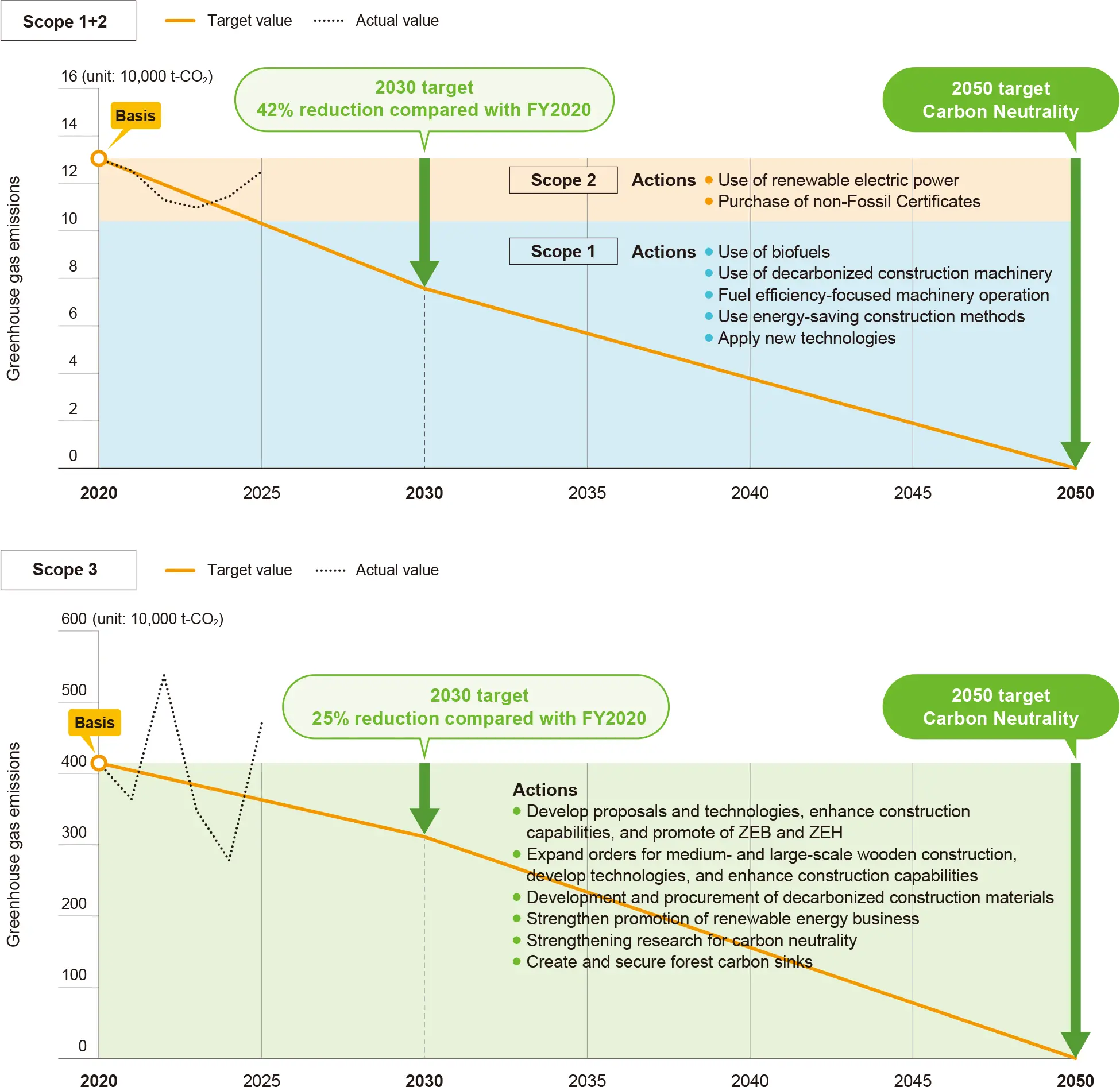
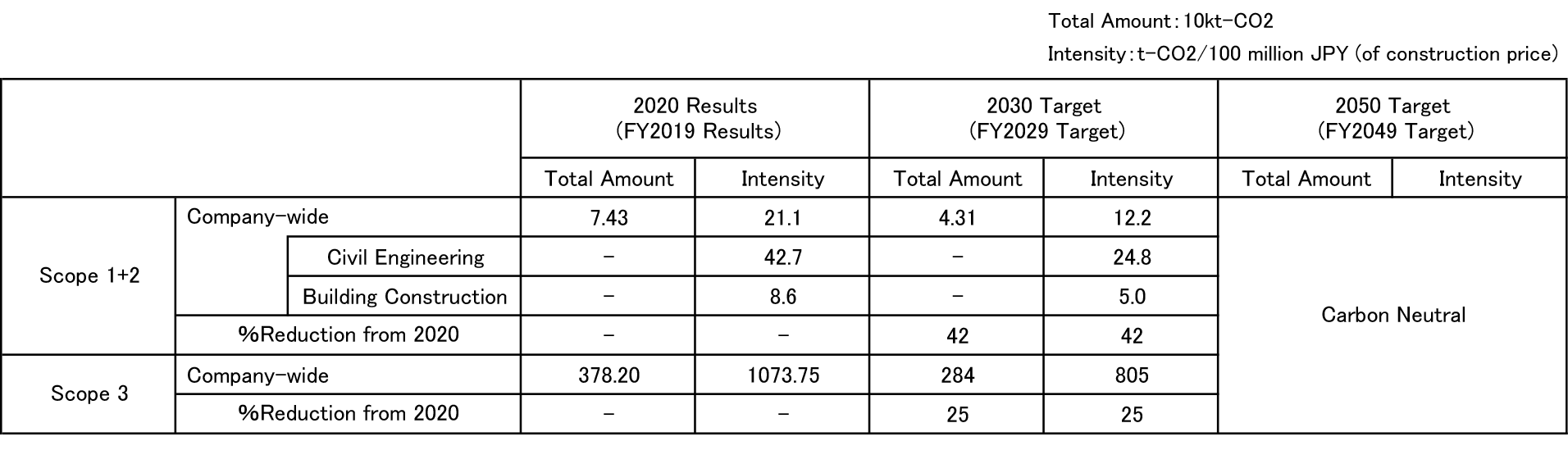
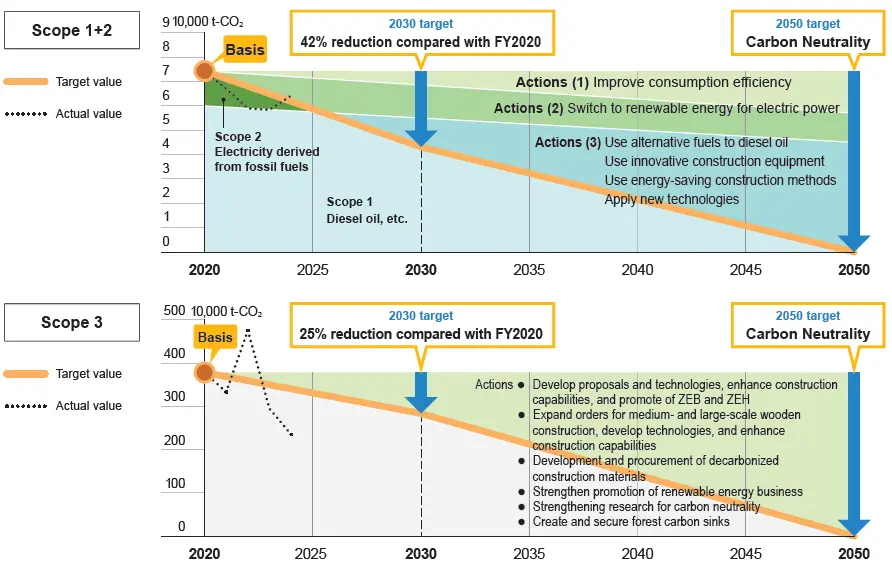
The Kumagai Gumi Group aims to achieve carbon neutrality by 2050 and has set a specific reduction target for 2030. For Scope 1 and Scope 2 emissions, the Group plans to reduce greenhouse gas emissions by 42% compared to 2020 levels, and for Scope 3, by 25% over the same baseline.
In the future, we will further reduce fossil fuels used in heavy machinery and vehicles in our business activities and actively introduce renewable energy. In addition, we will promote ZEB, which contributes to significant energy savings in the buildings we provide and work on renewable energy generation projects.
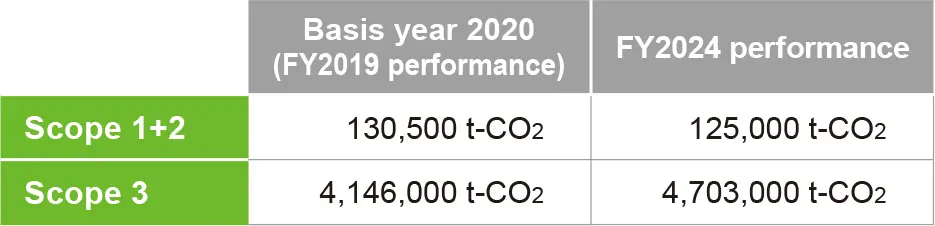
The Kumagai Gumi Group’s greenhouse gas emissions
The Kumagai Gumi Group’s greenhouse gas reduction targets
Initiatives Aimed at Carbon Neutrality
1. Status of Scope 1 CO2 reduction measures
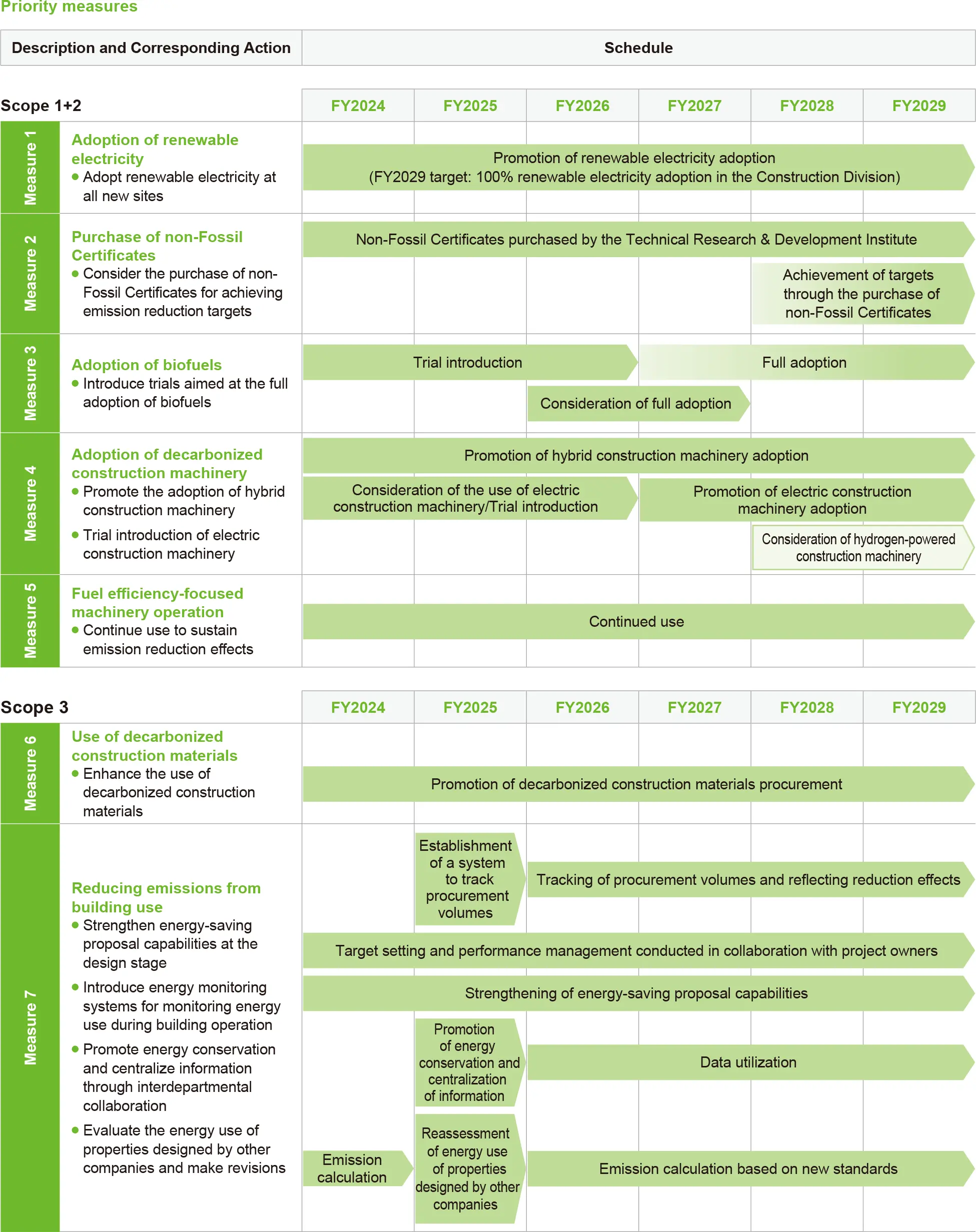
Measures in addition to the continued use of hybrid construction machinery, Kumagai Gumi trialed the use of B100 biofuel in site office generators and introduced K-S1 fuel additives in FY2024 to improve fuel efficiency in heavy equipment. For FY2025, the company plans to pilot alternative fuels to diesel for use in construction machinery.
2. Status of Scope 2 CO2 reductions
The Kumagai Gumi Group has set a target to source 100% renewable electricity for its business operations by 2050. Kumagai Gumi itself is accelerating this goal, aiming to achieve 100% renewable electricity use by 2030.
(1) Purchase of renewable energy menu
Full-scale efforts to introduce renewable electricity in the Construction Division began in FY2022, yielding measurable results. Starting in FY2025, all new construction projects will use renewable electricity.
Rate of adoption of renewable electricity and targets (Construction Division)
(2) Creation of renewable energy sources
Since FY2021, we have generated electricity at the Technical Research & Development Institute, Fukui Office, and Karuizawa Training Center using selfconsumption solar power generation. In January 2022, the Technical Research & Development Institute adopted self-consumption type solar power generation facility (roof type, carport type), as well as battery systems as a BCP measure. This creates more than 30% (max.) of the electricity used.
(3) Procurement of non-Fossil Certificates
The Technical Research & Development Institute has been continuously procuring non-Fossil Certificates since FY2022. In FY2024, it secured non-Fossil Certificates equivalent to 792,547 kWh of renewable energy value, achieving carbon neutrality for the Technical Research & Development Institute.
3. Status of Scope 3 CO2 reductions
Kumagai Gumi is actively working to reduce Scope 3 Category 1 (Purchased Goods and Services) and Category 11 (Use of Sold Products) emissions, which constitute the bulk of its Scope 3 emissions. Category 1: The company is strengthening the adoption of decarbonized construction materials and pursuing quantitative assessment of their emission reduction effects. Category 11: For in-house designs, Kumagai Gumi is enhancing its energy-saving proposal capabilities during the design phase and has begun centralizing internal energy efficiency data. For externally designed projects, the company is implementing energy-saving proposals and has initiated a review of its emissions evaluation methodology.
The KumagaiGumi Group CO2 emissions breakdown (FY 2024)

Scope 3 is calculated for Categories 1 to 7, 11 to 13
Indicators and Targets
Specific issue: Accomplishment of carbon neutrality
- Specific initiatives: CO2 emissions reduction activities
- Indicators: Scope 1+2/Scope 3 emissions reduction rates (FY2019 base year, FY2029 targets)
- Targets: Scope 1+2: 42% reduction/Scope 3: 25% reduction
Measures for Achieving 2030 CO2 Emission Reduction Targets
In FY2024, Kumagai Gumi formulated a set of priority measures to help achieve its CO2 emission reduction targets for 2030. Moving forward, the company will promote these initiatives company-wide, regularly evaluate progress, and revise countermeasures as needed.