
Business Risk
With respect to its business and accounting status, the Kumagai Gumi Group has recognized the following as the major risks that will have significant impact on its financial conditions, business results, and cash flow. The following, however, is not an exhaustive list of all the risks associated with the Group, some of which are not considered significant and may be difficult to foresee at this point in time. Forward-looking statements in the text are based on the Group's judgment as of the end of fiscal 2020.
1.Risk management structure
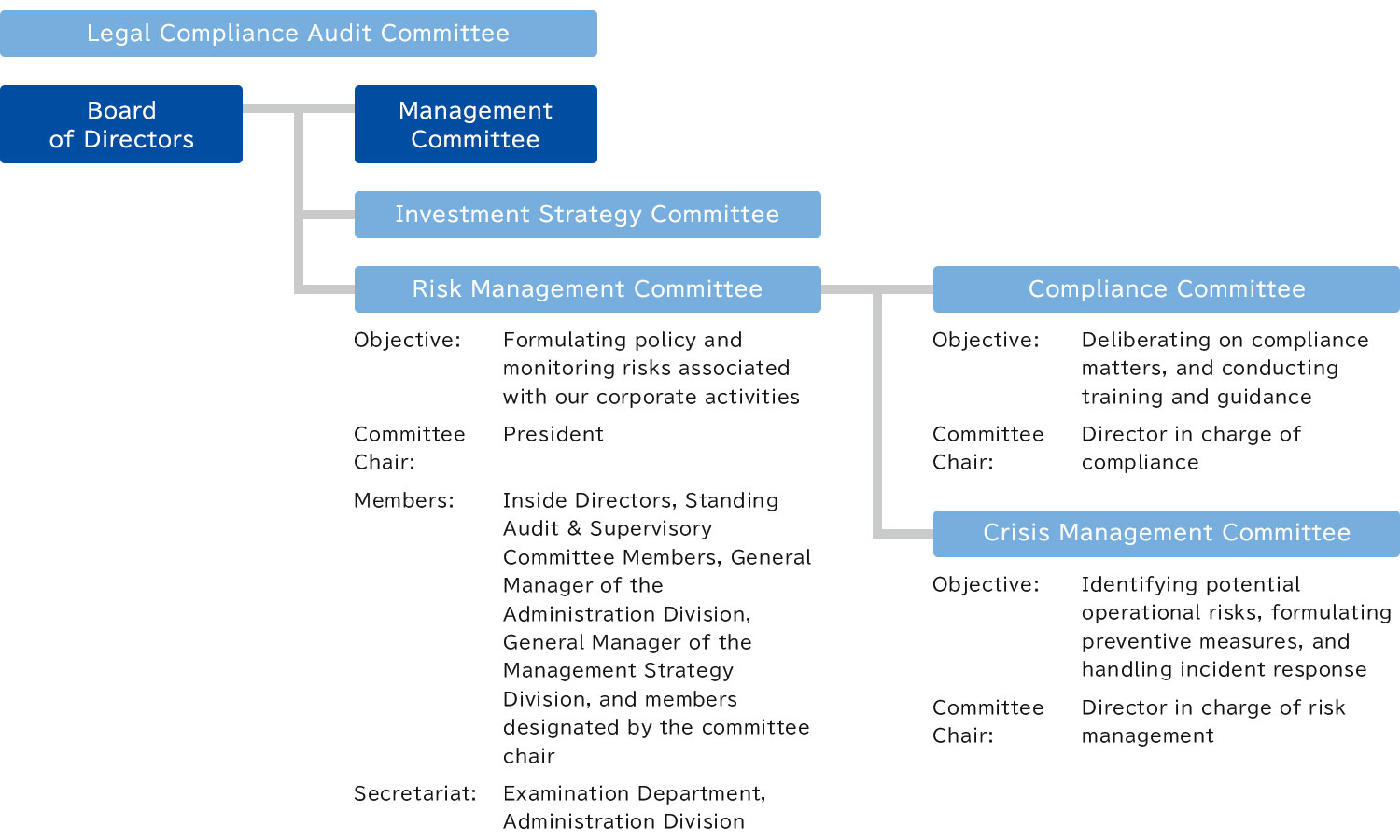
In April 2025, to prevent and mitigate business execution risks, Kumagai Gumi established the Risk Management Committee, which is chaired by the President. Intended to clarify responsibilities for risk oversight and to centrally manage the risks facing individual sections and countermeasures against them, this Committee promotes increased companywide risk management in the group's activities. Key efforts include preventive measures to address potential business risks, study and instruction regarding countermeasures to risks that have materialized, and comprehensively ascertaining and managing risks by checking risk management reports based on monitoring and other activities. It also strives to strengthen Group governance structures by clarifying lines of reporting and through the promulgation of and compliance monitoring for the Group's shared rules, in this way sharing and integrating risk-related attitudes and actions throughout the Kumagai Gumi Group.
2.Major risks
Of the items described in the Securities Report related to business conditions, accounting, and similar matters, the major risks recognized by management to have the potential to seriously impact the financial standing, business results, and cash flows of consolidated companies are reviewed below. Note that these do not encompass all risks associated with the Kumagai Gumi Group. Other risks may emerge that are not considered significant at this time or that are difficult to forecast.
Forward-looking statements contained in this document reflect judgments as of the end of the current consolidated fiscal year.
(1) Trends in construction investment
The main clients of the Kumagai Gumi Group's construction business are public agencies and private sector businesses. Medium- to long-term trends in construction investment often fluctuate with fiscal conditions, policies, and other factors related to public agencies and with economic conditions, consumer trends, and other factors affecting private sector businesses. While construction investment in Japan is trending up, were this investment to decline, competition for orders may intensify, reducing orders received and construction profitability.
To establish a corporate structure capable of adapting to qualitative and quantitative changes in the construction marketplace, the Kumagai Gumi Group has established Management Policies for 2030 and Beyond, its long-term vision. The Group is implementing various measures under the Mid-term Management Plan based on these policies. The long-term vision and the Mid-term Management Plan are described under "1. Management Policies, Business Environment, Issues to Address, etc." in "Part 2. Business Conditions."
(2) Fluctuations in the costs of construction materials and labor
We strive to conclude construction contracts at appropriate prices in light of various factors, including the cost of construction materials and labor. Nevertheless, in certain cases, the cost of construction materials and labor may rise after a contract is concluded. While requests after the fact may be submitted in the public sector to cover rising costs, similar cases in the private sector may require consultation with the client, which may result in insufficient payment amounts to cover the cost increases. Such inflationary conditions require various precautionary measures, including estimating construction prices that incorporate potential price increases and procuring materials in the early stages.
(3) Shortage of skilled construction workers
Numbers of skilled construction workers in the construction industry are declining due mainly to aging workforces and low hiring and retention rates among young workers. Amid expectations of large-scale retirement of older workers over the medium-to-long term, there is a pressing need to secure and develop workers to take their place. Should numbers of skilled workers decline still further in the future, labor costs may rise alongside intensifying competition for labor, and the inability to secure personnel may reduce construction capacity and orders received.
In cooperation with Yuuei Kyoryoku Kai, an organization of construction partners centered on specialized construction companies, the Kumagai Gumi Group is seeking to establish a stable construction structure, address the shortage of skilled workers, and secure capable human resources. In line with the construction industry's current mission of raising skilled worker salaries to the average for workers in all industries, we are shifting to a system of two full days off per week at construction sites, in addition to establishing programs to certify highly skilled workers, pay allowances, and introduce construction career improvement programs to create environments in which workers can earn compensation corresponding to their skills and experience.
(4) Securing human resources
Despite growing investment in construction, the construction industry faces a shrinking pool of construction workers. The Kumagai Gumi Group recognizes the pressing need to secure and train capable human resources to improve both earnings and quality. In response, in addition to expanding programs like the job return system for human resources with construction management experience and hiring new graduates, we are promoting diversity by proactively employing seniors, women, and non-Japanese workers.
In bidding for construction projects and in construction management, it is essential to assign technicians who have construction experience or the specific qualifications for each type of work. A lack of sufficient qualified personnel may reduce opportunities to secure orders and result in less orders received. Cases have already emerged in which we have chosen not join the bidding for certain types of construction due to the inability to secure the requisite staff for the timing required by the order. To ensure preparedness for future construction projects, we are teaching specialized knowledge through in-house training in specific fields and tiers while systematically providing technicians with experience related to a broad range of construction tasks. Through in-house courses, mock exams, and other measures, we are also striving to support and encourage workers to earn official qualifications, including Professional Engineer and First-class Architect/Building Engineer qualifications.
(5) Overseas business development
Currently, the Kumagai Gumi Group's overseas businesses are focused on construction in Asia. These overseas businesses are exposed to the risk of operational delays or suspensions in the event of significant disruptions in political, economic, or social conditions or the revisions of laws and regulations in the countries in which we operate. Other risks include those related to difficulties in billing and collecting appropriate construction proceeds or the obligation to bear unexpected costs due to factors such as underdeveloped laws and regulations, social systems, and differences in cultures or commercial practices. For this reason, the Kumagai Gumi Group seeks to operate only in countries and regions where it is highly knowledgeable of the local conditions. In principle, the Group undertakes only construction work for Japanese overseas development aid (ODA) and projects for Japan-affiliated firms.
Overseas businesses involve transactions in local currencies or US dollars, as well as the conversion of foreign currency assets, liabilities, revenues, and expenditures to Japanese yen under certain standards. Given the current scale of the Kumagai Gumi Group's overseas businesses, the impact of fluctuating exchange rates is minor. Nevertheless, we seek to minimize foreign exchange risks by matching the currency composition and timing of transaction revenues and expenditures or employing forward foreign exchange contracts.
(6) Impacts of natural conditions and natural disasters on the construction business
For construction work under certain natural conditions, geological, ground, and climate conditions pose the risk of rising construction costs associated with revised construction methods, rework, or other results of failing to ascertain such conditions in advance. Earthquakes, typhoons, flooding, or other natural disasters may affect work sites and lead to significant interruptions of construction or require costly and time-consuming recovery.
The Kumagai Gumi Group undertakes thorough research and studies of construction methods and other measures in advance to avoid declining construction profitability attributable to natural conditions and other factors. It also draws on insurance and other protective measures to minimize the damages caused by natural disasters.
(7) Pandemics
Global pandemics may reduce profitability due to delays in construction periods associated with the interruption of construction work, delays in the delivery of materials and equipment, and other unanticipated costs, including costs for infection-prevention measures. They may also reduce orders received due to slowing capital investment, chiefly by private sector firms.
(8) Defects in construction work
Construction involves widely varying building specifications, construction conditions, and other factors and is subject to various unexpected external factors. Given the difficulty of entirely eliminating such risks, we record appropriate amounts of reserves to account for remediation costs. However, in the event of major defects in construction work, the resulting repair costs or compensation for damages may exceed such reserves. Such cases may ultimately also reduce orders received due to the loss of social trust in the Kumagai Gumi Group.
The Kumagai Gumi Group strives to provide high-quality products and services through the appropriate implementation and continual improvement of its quality management system for project design and construction work.
(9) Occupational injuries and accidents in the construction business
Due to the nature of the working environments and the work itself, the construction business involves the risk of occupational injuries that are more severe than in other industries, as well as the higher likelihood of accidents that affect third parties. Serious occupational injuries or accidents can lead to significant indemnification obligations or other costs, as well as the loss of social trust and the suspension of bidding eligibility by government agencies, which would affect the orders received.
Recognizing countermeasures against occupational injuries and accidents to be a top priority, the Kumagai Gumi Group strives to eradicate such injuries and accidents through the rigorous implementation of its health and safety management system, including safety training, regular safety inspections, enhanced cooperation between construction and safety sections, and careful construction planning.
(10) Impairment of fixed assets and securities
The Kumagai Gumi Group acquires real estate as part of its efforts to create new businesses, such as urban revival and redevelopment businesses. A sharp decline in returns on asset holdings or in market prices due to marked worsening of the business environment may lead to impairment losses on fixed assets. The Group also holds securities issued by clients, partner companies, and other entities for purposes such as securing earnings opportunities and strengthening relations. Declining business performance or declining market prices of such investments poses a similar risk of impairment losses.
Kumagai Gumi establishes evaluation methods for individual assets and investment standards to quantitatively manage risks related to investment and finance activities. For those with large financial impacts, the Management Committee and the Board of Directors study their acquisition from the perspectives of projected management KPIs and maintenance of financial discipline. If it is determined after acquisition through monitoring to verify profitability that profitability is expected to worsen and there is only a very small likelihood that earnings could recover to above the base level in the future, or, for securities, that their holding would not be beneficial to the Kumagai Gumi Group's business execution, then we strive to minimize losses through means such as considering their sale.
(11) Client and business partner credit
One element of the construction business is the risk that notes and accounts receivable and other claims may prove uncollectible in certain events, including the loss of creditworthiness or bankruptcy on the part of the client after the start of construction. Other risks include delays in construction periods and rising construction costs if similar conditions come to affect a construction partner or other such party.
The Kumagai Gumi Group assesses client credit, reviews contractual details, and considers methods for preserving claims through its committees and specialized sections. Additionally, we strive to ensure effective credit management through in-house rules, including rules related to claim management regulations and standards for determining credit lines before concluding construction contracts. We assess the creditworthiness of business partners based on their most recent financial statements before commencing new transactions. For construction partners with whom we engage in transactions at or above certain amounts or volumes, we assess overall management conditions annually through interviews and other means, in addition to our financial assessments.
(12) Compliance violations
Our business operations are regulated by laws including the Construction Business Act, the Antimonopoly Act, and the Financial Instruments and Exchange Act. Any violations of laws and regulations and acts counter to the demands of society-for example, quality misrepresentations or accounting improprieties-may lead to criminal penalties, administrative sanctions, or liability for damages. They may also damage the trust of clients, shareholders, business partners, and other stakeholders.
To address such risks, the Kumagai Gumi Group has established rules and regulations, including the Code of Conduct and Compliance Rules of Conduct, and an internal whistleblowing hotline. The Group continually enhances various checks and balances in its everyday operations as part of its compliance systems. The Legal Compliance Audit Committee is set apart from management to allow assessment and advising by outside experts. Through compliance training and other educational programs, we strive to strengthen awareness of compliance and ensure a thorough understanding of compliance issues among all our officers and employees.
(13) Environmental issues
We understand that the international community must address the various environmental issues attributable to global population growth and the rapid growth of industrial activity, including resource depletion and global warming. The construction industry, which is responsible for maintaining social capital and infrastructure, must act proactively to reduce its environmental impact, including CO2 emitted during construction work and at other times, construction waste, and soil resulting from construction work. This generates ongoing costs. Construction work is subject to regulation under various environmental and other laws and regulations, while soil pollution, water pollution, and other environmental incidents may not only generate costs associated with recovery, damages, and compensation, but reduce orders received due to loss of social trust in the Kumagai Gumi Group.
Kumagai Gumi strives to minimize its environmental impact and to create a better environment by effectively and appropriately operating and continually improving its environmental management systems. Based on our pledge to put the environment first, we strive to reduce CO2 emissions and mixed waste from construction sites, promote a low-carbon and cyclical society through green procurement, and work to comply with environmental standards and prevent environmental incidents.
(14) Information security
Breaches of information security leading to system downtime and suspension of operations or leakage of personal or customer information, information on construction projects underway, or other information related to provision of design, construction, and other services resulting from cyberattacks such as unauthorized access by intruders can result in the loss of clients due to impairment of its credibility or obligations to provide compensation for damages, which can affect financial results, business continuity, and other aspects of our business.
To address such risks, the Kumagai Gumi Group has established an information security policy consisting of the basic information security policy and the information security standards. In addition to prioritizing control of information security, we have also established the Kumagai Gumi Group Computer Security Incident Response Team (KUMA-CSIRT) to enhance information security incident prevention measures and the structures for responding to such incidents.